
What Are CRUD Operations? Create, Read, Update, Delete Explained for Developers
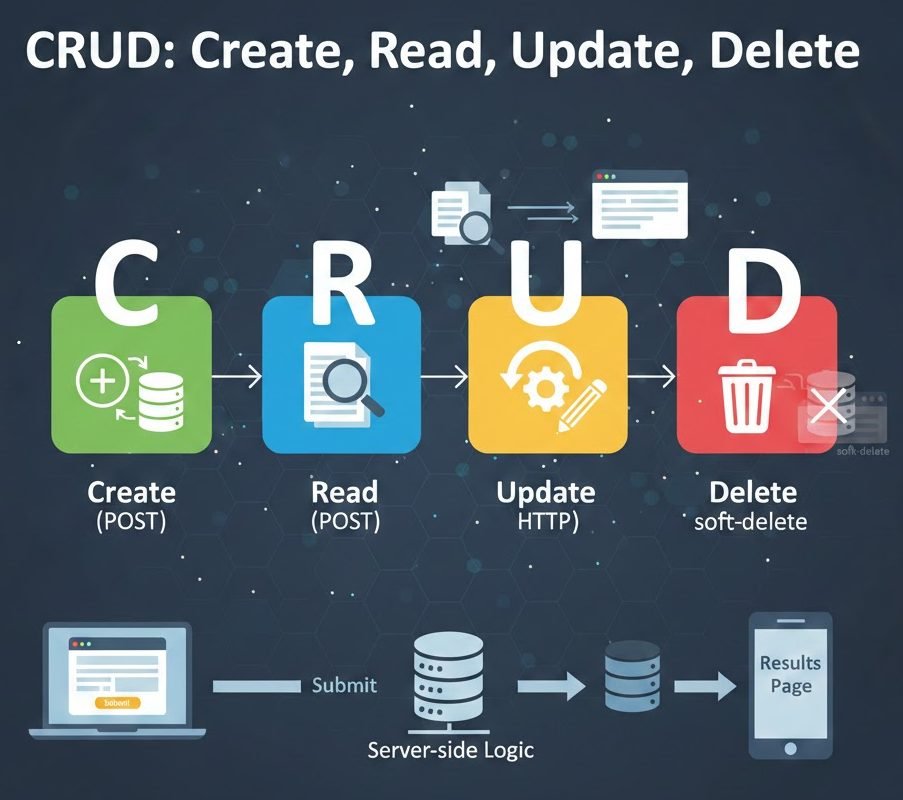
CRUD Operations: The Foundation of Data Management
In modern software development, CRUD operations are the core framework for managing data in any application. Whether you’re building a simple blog or a large‑scale enterprise API, your system will rely on these four essential actions to interact with a database.
If you want to learn how to use CRUD operations step‑by‑step inside a real application, visit this course.
What Does CRUD Stand For?
CRUD represents the four primary functions of persistent storage. These operations appear in every major programming language and database system.
1. Create (POST)
Create adds new data to the system.
- User Action:
Signing up, publishing a post, submitting a form - Technical Side:
The application sends an INSERT command. In REST APIs, this maps to POST.
2. Read (GET)
Read retrieves existing data and is the most common operation.
- User Action:
Viewing profiles, browsing products, loading dashboards - Technical Side:
The system performs a SELECT query. In APIs, this uses GET.
3. Update (PUT/PATCH)
Update modifies existing records.
- User Action:
Editing a profile, changing settings, updating a cart - Technical Side:
The app sends an UPDATE command. REST uses PUT for full replacements or PATCH for partial updates.
4. Delete (DELETE)
Delete removes data from the system.
- User Action:
Removing a comment or deleting a file - Technical Side:
The system executes a DELETE command. - Pro Tip:
Many apps use soft deletes to hide data instead of permanently removing it.
CRUD and REST API Mapping
| CRUD Operation | SQL Command | HTTP Method |
|---|---|---|
| Create | INSERT | POST |
| Read | SELECT | GET |
| Update | UPDATE | PUT / PATCH |
| Delete | DELETE | DELETE |
The Typical CRUD Workflow
A complete CRUD application includes:
- UI:
Forms, buttons, and interactive elements - Controller/Server Logic:
Validation, authorization, and request handling - Database:
Systems like MySQL, PostgreSQL, or MongoDB - Response Layer:
Redirects, messages, or JSON output
Why CRUD Matters for Developers
Mastering CRUD gives developers a universal blueprint for building data‑driven applications. No matter the stack—PHP, JavaScript, Python, or any other language—the CRUD pattern remains the same. Once you understand these four operations, you can design almost any interactive system with confidence.
